EphraimHill DC- Weekly Civic Data Intelligence | 05 Sept 2026 | Idowu Ephraim Faleye +2348132100608
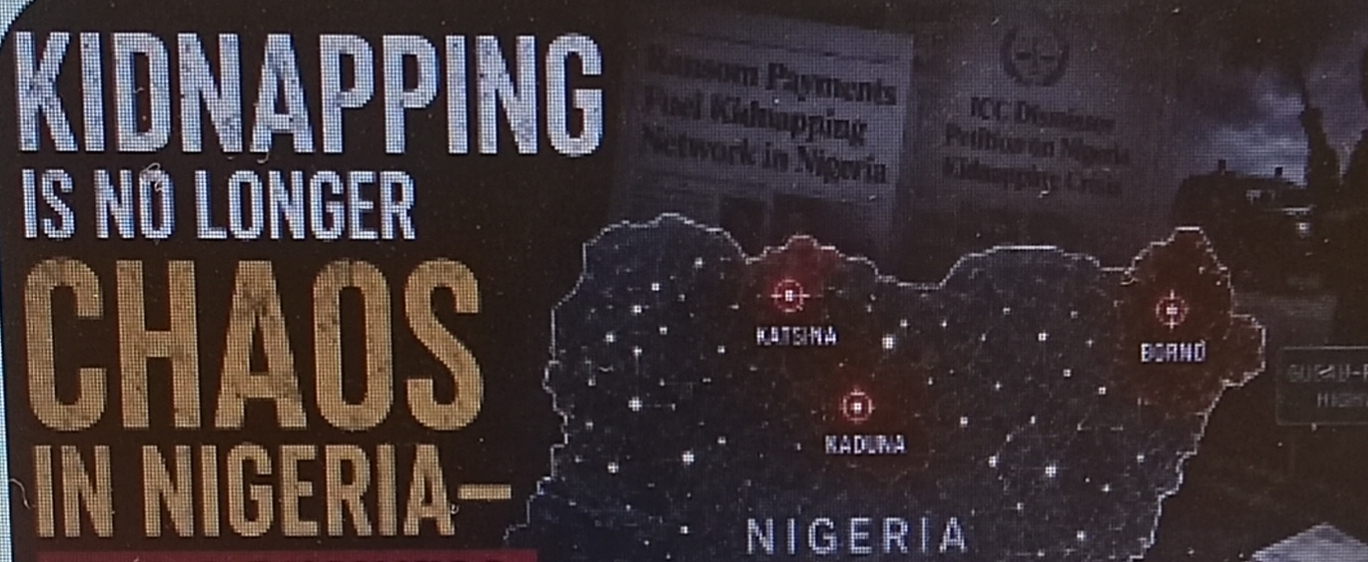
Kidnapping Is No Longer Chaos in Nigeria. That is the uncomfortable picture emerging from two very different developments this week. On one side, the International Criminal Court dismissed a petition asking it to treat Nigeria’s kidnapping crisis as a crime against humanity. On the other side, findings from SBM Intelligence show that kidnapping in Nigeria has developed into a financially sustainable system, with billions of naira being paid in ransom. When these two developments are looked at together, they point to a problem that goes beyond isolated criminal incidents: kidnapping is becoming a system that is being sustained by money.
On September 1, 2026, the ICC’s Pre-Trial Chamber II dismissed a petition from an unnamed individual who had asked the court to investigate what the petition described as systemic kidnappings in Nigeria as crimes against humanity. The court found that the petition did not have a proper legal basis. That decision does not mean that kidnapping in Nigeria is a small or unimportant problem. Rather, it means that the issue, in its present form, has not been presented in a way that gives the ICC a legal basis to act, leaving Nigerian institutions with the main responsibility for addressing the problem.
That is where the evidence from SBM Intelligence becomes important. Its findings suggest that kidnapping in Nigeria is financially sustainable for the criminal groups involved because ransom payments provide them with the resources to continue operating. When an organised group can repeatedly make money from abducting people, the crime becomes more than an opportunity taken by individuals; it can become a source of financing for recruitment, weapons and expansion. In simple terms, the ransom paid for one kidnapping can help create the conditions for another kidnapping.
Read Also: Tinubu’s Rainbow Coalition Is Outpacing Nigeria’s Opposition -And the Data Proves It
The numbers also suggest that this money is not necessarily spread evenly among every criminal group involved. A smaller number of large and organised groups appear to be capturing a significant share of the ransom value. That matters because it points toward a more organised financing model rather than random criminal activity, and it raises a difficult question for Nigeria’s security response: what happens if the financial system sustaining these groups is left largely untouched?
Interestingly, the EphraimHill DC dataset for the week of August 30 to September 5, 2026, recorded only two articles specifically classified under Kidnapping. One concerned the ICC decision, while the other came from Ebonyi State, where the police said reports of mass kidnapping and a terror group operating in Izzi Local Government Area were false. The Ebonyi story mentioned Okemini Ogbonna, police spokesperson SP Joshua Ukandu and Auwalu Mahmuda, and was reported from Abakaliki by the News Agency of Nigeria.
At first glance, two kidnapping articles in a whole week might appear reassuring. But that is exactly where the data requires us to slow down before concluding. The sentiment attached to those two stories was evenly split at 50 percent positive and 50 percent negative, largely because the police denial created a positive signal even though the story itself was responding to public fear about kidnapping.
Read Also: Frozen Accounts, Fiery Politics: How the EFCC Standoff Changed the Osun Election Story
More importantly, two articles are a very small number when compared with the wider evidence about kidnapping in Nigeria. It may indicate that kidnapping is being under-represented as a specific topic in the news rather than that the threat itself has reduced. Individual incidents can easily be classified under broader labels such as “crime” or “security,” while some incidents may not receive national attention unless they involve a large number of victims, a major institution or an unusual development.
This is one of the most important lessons from this week’s data. A low number of articles tagged specifically as kidnapping can create the impression that the problem is quiet, even when kidnapping-related events are appearing elsewhere in the information environment. In other words, the way we classify the news can sometimes hide the scale of the problem we are trying to measure.
When we step back and look at the full week’s information environment, the picture becomes much clearer. The EphraimHill DC pipeline processed 2,366 articles from across the country, with 1,204 rated medium risk, 566 low risk, 499 high risk and 97 critical risk. Sentiment was also tilted toward the negative side, with 1,385 articles carrying a negative tone compared with 981 positive articles.
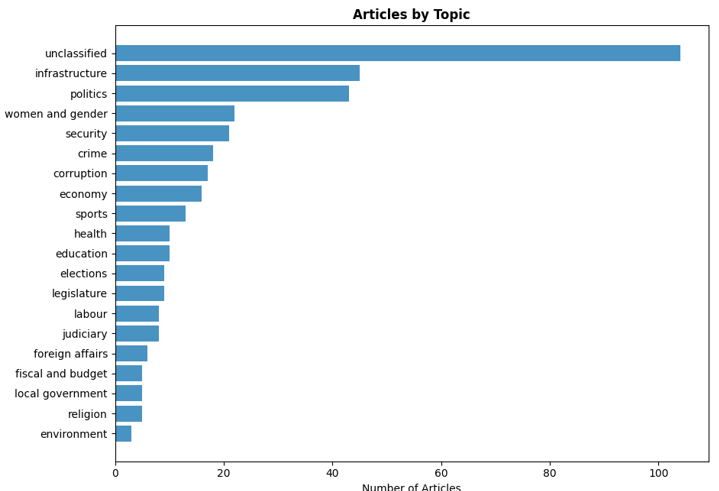
The topic distribution provides another useful clue. “Unclassified” was the largest category with 578 articles, followed by politics with 442, infrastructure with 272, and women and gender issues with 165. Security recorded 101 articles, corruption had 99, and crime had 92. When these three categories are placed beside the two articles specifically labelled kidnapping, it becomes clear that a significant part of the security story may be sitting inside wider classifications rather than appearing under the kidnapping label itself.
The security numbers were also more negative than positive, although the difference was not extreme. 44.7 percent of security articles were positive, while 55.3 percent were negative, with institutions such as the NSCDC appearing six times and the Federal Government five times. Crime coverage was much more negative, with only 14.3 percent positive against 85.7 percent negative.
Some of the crime stories help explain why that negative picture matters. A Lagos court jailed two people for money laundering, security stakeholders warned young people against political violence and cybercrime, and the police foiled a bandit attack on the Gusau-Funtua highway, rescuing nine people. That highway incident is particularly important when thinking about kidnapping in Nigeria because it shows that armed groups are still operating around routes used by ordinary travellers. The threat, therefore, is not limited to isolated locations; it can intersect with the everyday movement of people across the country.
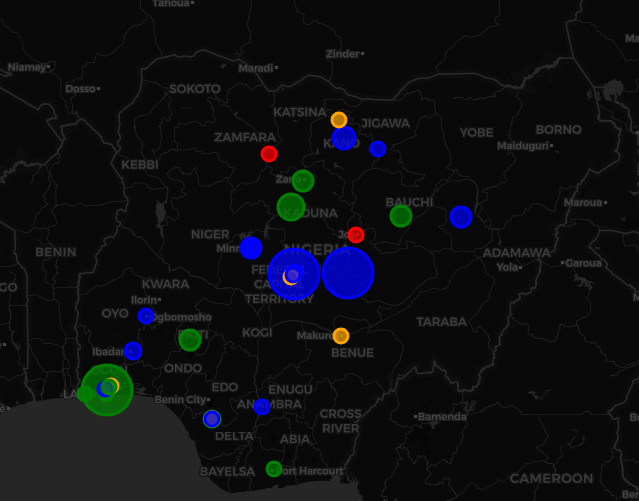
The geographical picture adds another layer to the story. Nigeria as a whole recorded 661 mentions, while Abuja led among specific locations with 228, followed by Lagos with 150 and Kaduna with 88. The United States appeared 192 times, largely in political and diplomatic coverage, while Port Harcourt recorded 50 mentions.
What this tells us is that security information does not spread evenly across the country. A single incident can dominate the news cycle of one state, while another area may receive little attention even when its underlying security situation is not necessarily better. This is why data professionals must be careful not to treat media volume as a direct measure of the actual level of insecurity on the ground.
The risk picture becomes even more serious when we examine the 97 critical-risk articles recorded during the week. Five stories stand out: the collapse of a political structure into the Kwara APC around Akeem Lawal; the police operation that stopped the Gusau-Funtua highway attack and rescued nine people; the injury of four soldiers while repelling a terror attack on a military base in Borno; Kaduna Governor Uba Sani’s push to advance his peace model; and the Nigerian Army’s warning about an attempted cyber breach of its X account. Taken together, these stories show that Nigeria’s risk environment is operating across several fronts, from physical attacks on highways and military facilities to political instability and attempts at digital infiltration.
The high-risk stories add further pressure to this picture. The Nigerian Army recovered two AK-47 rifles from a suspect in Plateau, while rising fuel prices at Abuja filling stations appeared in the high-risk category. These events may seem unrelated to kidnapping on the surface, but they form part of a wider environment in which security pressure and economic pressure can interact. For a country trying to understand why armed groups continue to find recruits and resources, these connections deserve continued attention rather than being treated as separate stories.
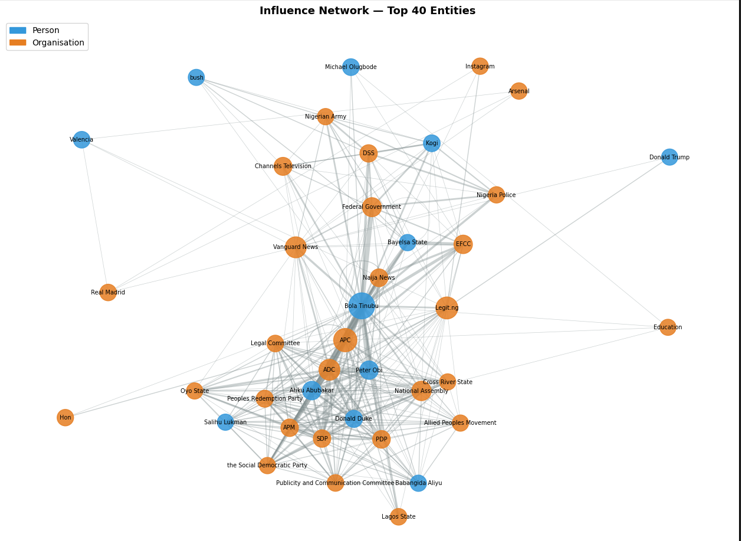
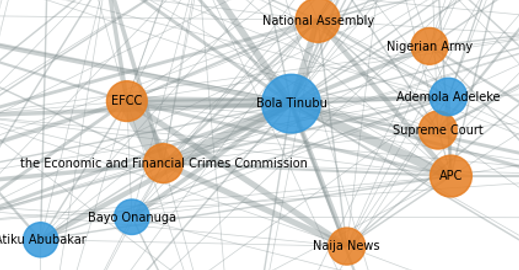
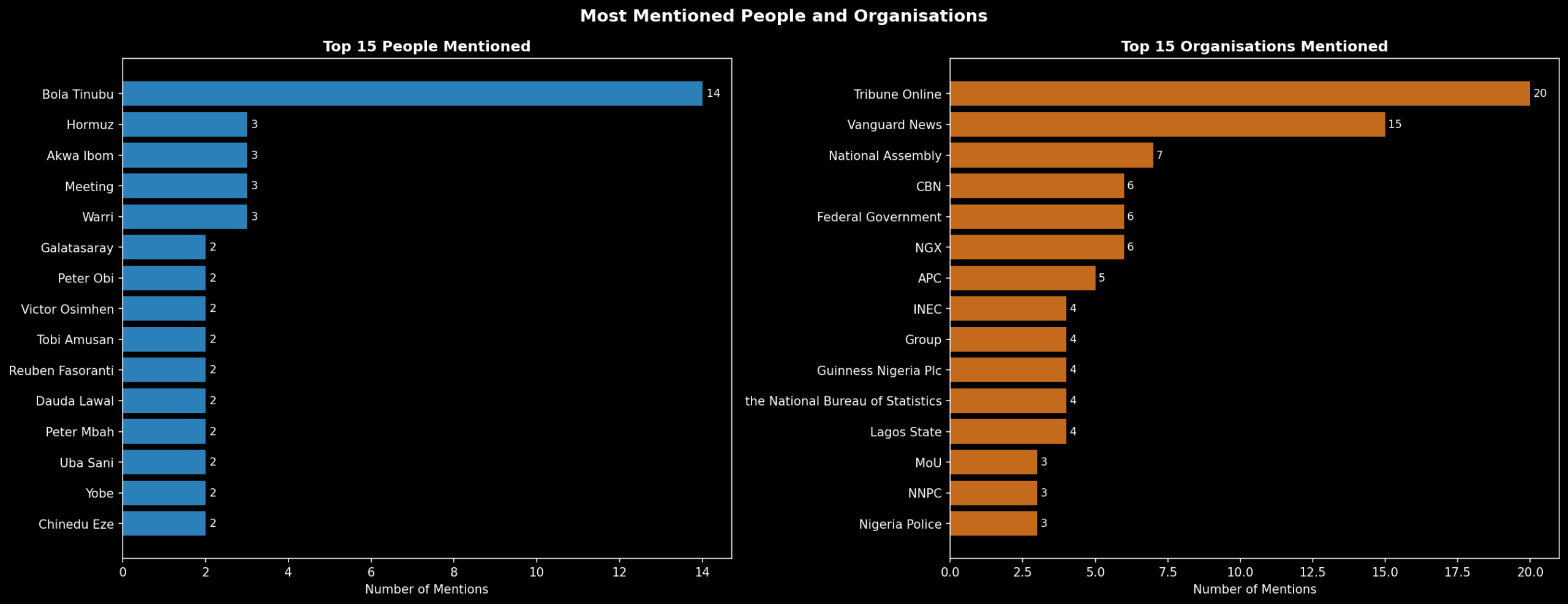
The people receiving the most attention in the week’s coverage also tell us something about how Nigerians are interpreting these issues. President Bola Tinubu was the most mentioned figure nationally with 394 mentions, including 15 within security coverage. Vice President Kashim Shettima recorded 37 overall and seven in security, while Atiku Abubakar had 137, Peter Obi 86, Nyesom Wike 45, and Donald Trump 43. Chief of Defence Staff Christopher Musa recorded 27 mentions, a relatively modest figure considering the military’s role in responding to several of the threats appearing in the critical-risk category.
This matters because public attention often connects security outcomes directly to political leadership. When security stories repeatedly mention the President or other senior officials, the public conversation gradually becomes a measure not only of what happened but also of how people judge the government’s response. That means security policy is being watched not just through official statements and operational results, but also through the volume and tone of the information surrounding it.
Overall sentiment remained negative throughout the week. Some of the strongest negative drivers included the DSS decision to suspend the Sowore cybercrime case until after the 2027 election, a morning news recap centred on Tinubu’s comments about his FBI records and INEC’s unveiling of 2027 governorship candidates, and low voter turnout in Anambra’s local government polls. Positive signals were more scattered, including governors gathering in Delta for a wedding and a story about a corps member’s sibling determined not to lose another family member after already losing their mother.
Looking ahead, the warning signs deserve careful attention. The ICC’s dismissal of the kidnapping petition closes one particular route for international intervention, placing even greater responsibility on Nigeria’s police, military, state governments and judiciary. At the same time, SBM Intelligence’s evidence that ransom payments are helping to sustain kidnapping groups suggests that arrests and rescues alone may not be enough if the financial channels behind the crime remain active. The question is therefore not only how many kidnappers are arrested, but whether the system that makes kidnapping financially attractive is being disrupted.
The recent Gusau-Funtua highway rescue and the Borno military base attack also suggest that armed groups continue to test both civilian and security infrastructure. We should therefore expect kidnapping-related risks to continue appearing under broader security and crime classifications rather than always arriving as stories explicitly labelled kidnapping. For anyone monitoring Nigeria’s security situation, this classification issue is not a technical detail; it can directly affect how the scale and direction of the threat are understood.
The real lesson from this week’s data is simple: a quiet topic count does not necessarily mean a quiet crisis. Two articles classified specifically as kidnapping may look insignificant when viewed alone, but they sit alongside a wider national security environment and SBM Intelligence’s evidence of a ransom economy worth billions of naira. Behind those ransom payments are families selling land, taking loans and organising community fundraising to bring loved ones home, meaning part of the financial burden of insecurity is quietly moving from the state to ordinary households.
That is why Nigeria’s response to kidnapping needs to go beyond reacting after an abduction has already happened. The country needs better classification of security incidents so that kidnapping is not unnecessarily hidden inside broader crime and security categories. It also needs stronger financial tracing to identify and disrupt ransom channels, as well as faster follow-through when information emerges from cases such as the Ebonyi denial or the Gusau-Funtua rescue.
For EphraimHill DC, this is precisely where Civic Data Intelligence becomes useful. The purpose is not simply to count headlines, but to examine what those headlines reveal about risk, sentiment, geography, institutions and emerging patterns. When 2,366 articles are analysed together, patterns that may be invisible in individual news reports begin to emerge, and those patterns can help decision-makers ask better questions about Nigeria’s security environment.
EphraimHill DC will continue tracking this story as it develops. The underlying dataset for this week’s analysis, including the articles, actor mentions and sentiment scores, is available in the Data Lab for further verification and analysis, while the Data Intelligence dashboard and geo-maps provide a continuously updated view of risk levels and geographical concentration. Next week, the question will be whether the low number of kidnapping-specific stories continues or whether what appears to be a quiet week was simply a gap in the way the story was classified and reported.
EphraimHill DC is Nigeria’s civic data intelligence platform, where we track, analyse, and interpret national developments to help Nigerians understand the deeper patterns behind public events. Our analysis is institutional, evidence-based, and politically neutral.


































![The Trend of Insecurity in Nigeria. [Part 2]](https://ephraimhilldc.com/wp-content/uploads/2024/09/Computer-Monitoring-of-Remote-areas.png)