EphraimHill DC- Weekly Civic Data Intelligence | 16 May 2026 | By Idowu Ephraim Faleye
Nigeria’s political atmosphere has become charged. This week, EphraimHill DC intelligence pipeline tracked a noticeable rise in election-related narratives across the country’s media ecosystem. Sixty separate articles focused on electoral themes out of 1,058 articles tracked across Nigeria’s media environment. This is a significant figure for a period that still sits outside the formal nationwide campaign window for the 2027 general elections. The campaign season is returning early, even as governance pressures intensify
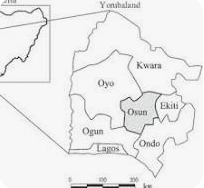
On the surface, the trend is understandable because the APC has already begun internal primaries and political positioning in parts of the country, while Ekiti State is moving toward its June 20, 2026 governorship election, and Osun State is gradually entering its own election cycle. Opposition parties are also quietly reorganising, coalitions are beginning to form, and political actors are already testing narratives and consolidating influence ahead of what is expected to be another highly competitive national election season.
Read Also: Nigeria’s Civic Data Intelligence: The Story Beneath the Headlines
None of this is unusual in isolation. Nigeria’s electoral system operates within a four-year constitutional cycle, and history shows that political actors rarely wait for formal campaign windows before beginning strategic positioning. INEC’s documentation of the 2023 election cycle showed that voter registration drives, stakeholder engagements, political mobilisation, and digital campaign activity intensified gradually long before voting eventually took place. Political preparation itself is therefore not the deeper issue. What deserves closer attention is how quickly election-centred discourse is beginning to dominate the national conversation at a time when Nigeria is simultaneously facing humanitarian crises, economic pressure, institutional distrust, and persistent insecurity.
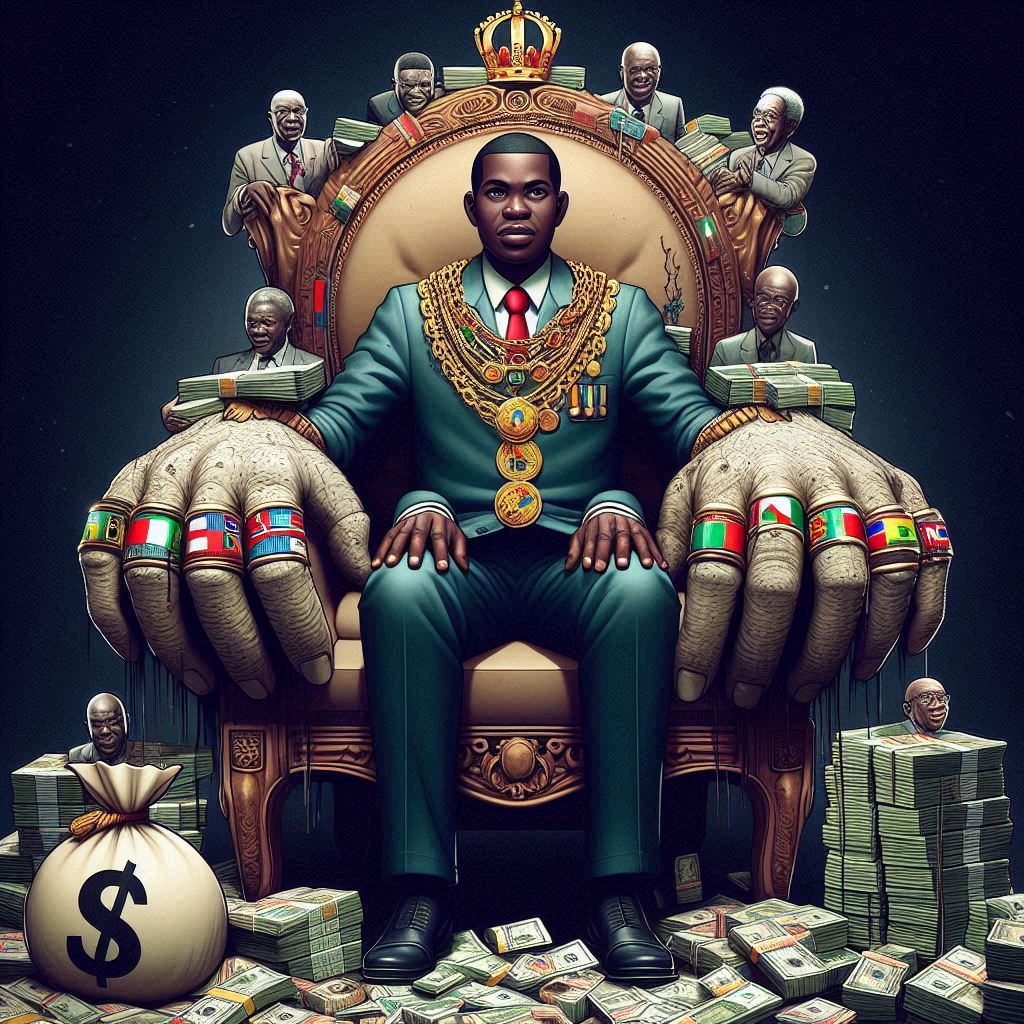
That contradiction matters because political atmospheres shape governance behavior. When election calculations begin dominating public discourse too early, governments, institutions, oppositions, and citizens gradually start interpreting national events through electoral logic rather than governance outcomes. Security operations begin to look like political messaging. Infrastructure projects become campaign assets. Public appointments are interpreted as coalition balancing. Over time, governance risks becoming secondary to political positioning.
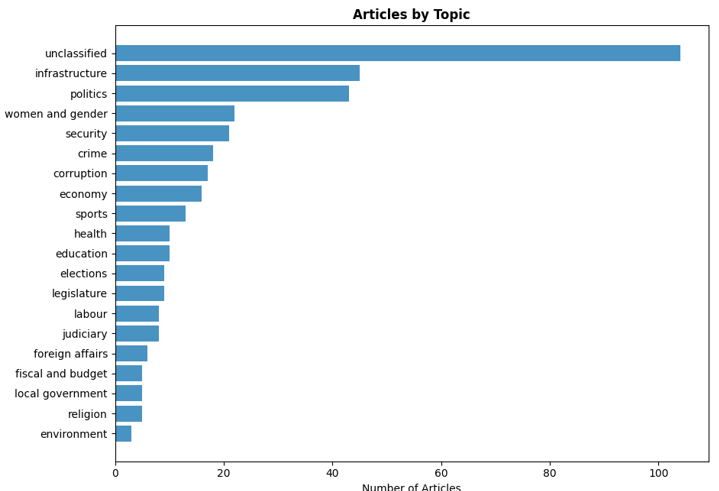
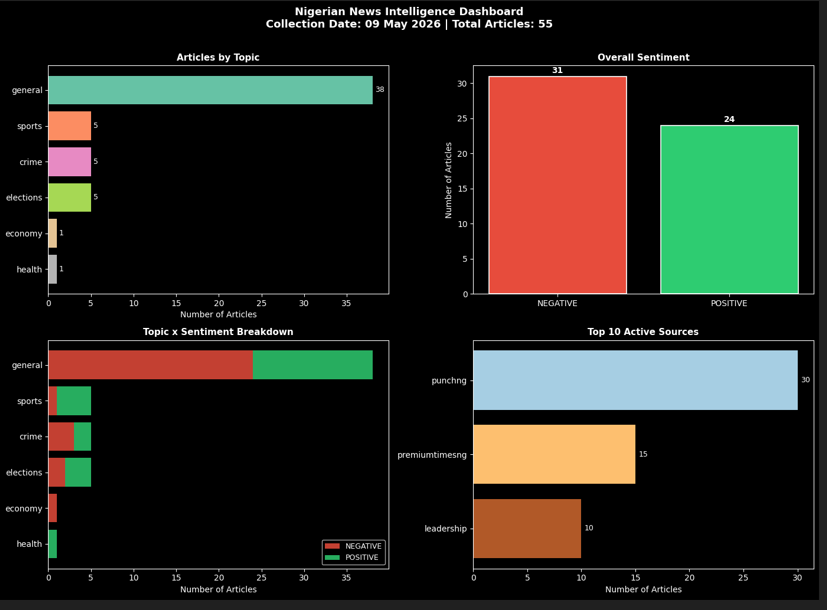
This week’s broader intelligence environment already reflects some of that tension. Out of the 1,058 articles tracked by the EphraimHill DC pipeline, 601 carried a negative tone, representing 56.8 percent of all monitored coverage. Additionally, 161 HIGH-risk stories and 14 CRITICAL-risk stories were identified during the week, bringing the total number of elevated-risk reports to 175. Crime emerged as the second most reported topic with 102 articles, while governance controversies, institutional accountability stories, and security operations remained highly visible. Yet despite these pressures, election discourse still occupied a significant share of national attention.
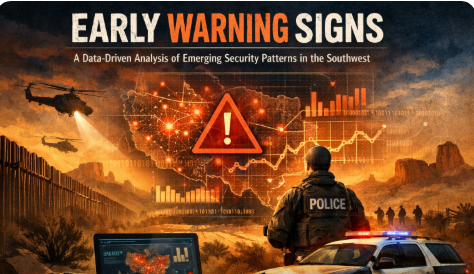
Read Also: The Cost of Ignoring Early Warnings: A Risk Projection for the Southwest Security
The signal becomes clearer when viewed collectively. Nigeria is not merely entering another political cycle. The country may already be entering a prolonged political atmosphere before many urgent governance challenges have stabilized. Historically, prolonged political seasons often reshape institutional priorities. Public communication becomes more strategic, political loyalty becomes more valuable, and long-term reforms become harder to sustain because immediate political calculations begin dominating institutional thinking. Nigeria has experienced this pattern repeatedly across previous democratic cycles.
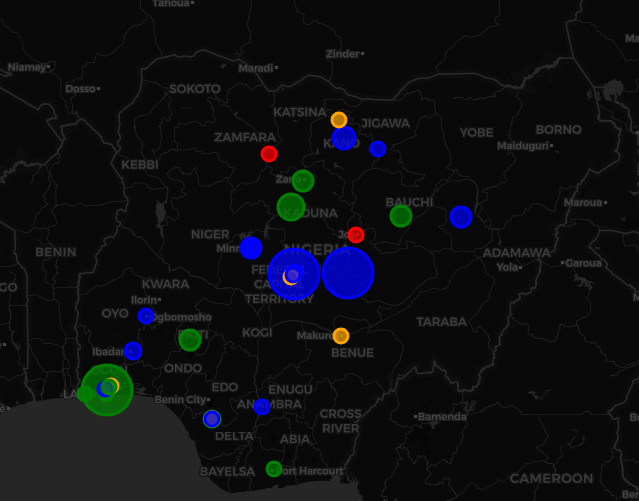
The humanitarian crisis emerging from Taraba State this week illustrates the danger well. According to reports tracked within the pipeline, more than 100 people were reportedly killed, approximately 98,000 displaced, and 217 churches destroyed in what appears to be one of the country’s most severe underreported humanitarian emergencies this year. Yet Taraba barely appeared among the dominant national geographic conversation clusters despite the scale of destruction being reported. Abuja recorded 126 mentions in the national conversation, while Lagos recorded 114. The imbalance between humanitarian severity and national visibility is itself an important signal.
This does not necessarily mean the media deliberately ignored Taraba. Political stories naturally move faster, attract stronger reactions, and generate continuous commentary cycles. However, the long-term consequence is that humanitarian crises sometimes struggle to sustain national urgency in heavily politicized environments. Electoral maneuvering gradually overshadows deeper governance. This pattern has appeared repeatedly across fragile democracies where political competition intensifies while peripheral instability worsens quietly beyond sustained public attention.
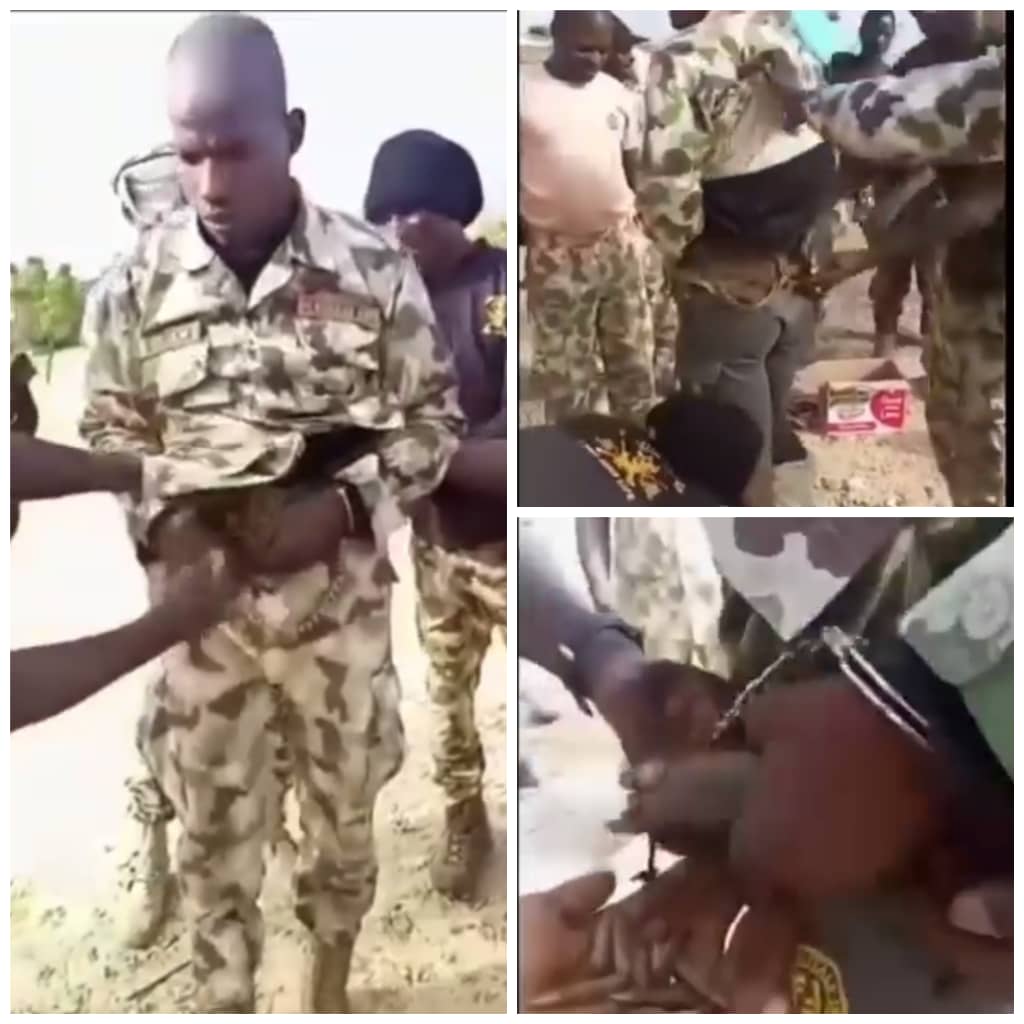
At the same time, institutional trust continues to emerge as one of the deeper themes connecting many of this week’s major stories. The viral Customs extortion video became more than a misconduct incident because it triggered wider conversations about accountability and abuse of power. Likewise, the Nigerian Bar Association’s demand for the release of an abducted lawyer in Abuja transformed what could have been treated as a routine crime report into a broader rule-of-law concern. A lawyer being abducted in the federal capital carries symbolic implications because Abuja represents the institutional center of the Nigerian state itself.
The role of digital communication in this evolving atmosphere also deserves attention. Historical evidence from the 2023 election cycle showed how rapidly youth participation and online political engagement expanded once electoral momentum intensified. INEC itself documented concerns surrounding misinformation, digital manipulation, and social media-driven tensions during the last election period. Nigeria’s political communication environment has become even more digitally accelerated since then. Election narratives now spread through influencer networks, viral clips, coalition rumors, and online commentary long before formal campaigns officially begin.
Read Also: The Cost of Ignoring Early Warnings: A Risk Projection for the Southwest Security
This creates what analysts increasingly describe as an extended political environment where electoral psychology dominates national conversation far earlier than institutional timelines require. In such environments, citizens gradually begin interpreting nearly every national issue through partisan assumptions. Security operations become political signals. Economic decisions become electoral calculations. Public projects become campaign branding opportunities. Over time, this weakens civic trust because institutions are increasingly viewed through political suspicion rather than governance performance.
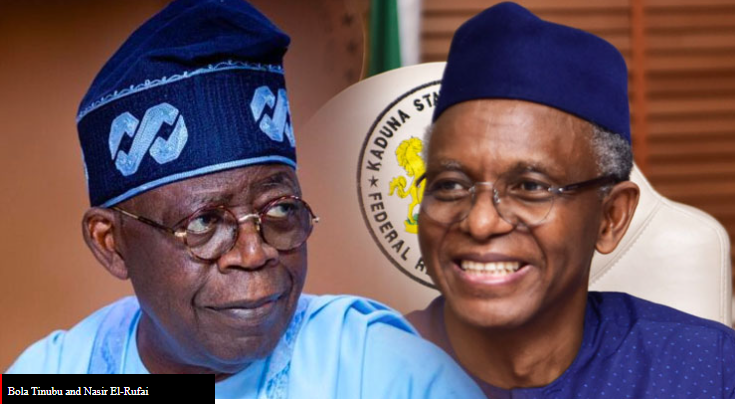
Abuja’s dominant position within this week’s geographic conversation reflects this atmosphere clearly. Much of the FCT’s visibility came from elite political activity, governance maneuvering, and coalition calculations. Lagos, meanwhile, reflected a different governance pattern. The contrast between Abuja and Lagos reveals something deeper about Nigeria’s governance structure. One center increasingly reflects political negotiation and elite maneuvering, while the other reflects the practical challenges of administering a complex urban environment. Healthy democratic systems require both dimensions to function simultaneously. Problems emerge when political activity begins consuming disproportionate national energy relative to governance delivery.
This is why the current rise in election-centered narratives deserves strategic analysis rather than emotional reaction. Nigeria is not facing an electoral crisis. Political activity itself is expected, particularly with Ekiti and Osun entering active electoral periods and national parties preparing early for future competition. However, the timing intersects with a fragile governance environment already under strain from economic pressure, insecurity, humanitarian displacement, and institutional distrust. The campaign season is returning early, even as governance pressures intensify.
Against that backdrop, a prolonged political season may carry risks that extend beyond elections themselves. The deeper concern is governance displacement, where urgent structural issues gradually receive reduced attention because electoral competition increasingly dominates public communication space. Democracies often struggle when political systems become permanently campaign-oriented because policy continuity weakens under constant electoral calculation. Nigeria must therefore manage the balance between democratic competition and governance stability carefully over the coming months.
Importantly, this does not require discouraging political participation or electoral engagement. Elections remain central to democratic legitimacy. However, democratic maturity is also measured by a society’s ability to sustain governance accountability between elections. A country cannot afford to suspend serious conversations about insecurity, economic management, institutional reform, healthcare, education, and humanitarian response simply because the political class has begun repositioning early.
This week’s intelligence findings suggest that Nigeria may already be entering one of its defining pre-election transitions. The country is not yet consumed by campaign frenzy, but the patterns are becoming visible. Political visibility campaigns are increasing. Elite alliances are becoming more active. Election-centred narratives are expanding within the media ecosystem. Digital political engagement is gradually accelerating. Public attention is beginning to tilt back toward electoral calculations even while governance pressures remain unresolved.
There are also reasons for cautious optimism. The campaign season is returning early, even as governance pressures intensify. Nigeria’s democratic system has continued to evolve despite multiple institutional pressures over the year. Some positive developments also received less attention than they deserved, including Nigeria’s participation in broader Africa CDC public health intelligence initiatives and the continuation of security operations in Kaduna and other regions.
The coming months will therefore matter greatly. The way political actors conduct themselves, the way institutions maintain operational focus, the way media organisations distribute attention, and the way citizens interpret national priorities could significantly shape Nigeria’s broader democratic stability. Political competition will continue to intensify because that is the nature of electoral systems. The real challenge is ensuring that governance does not quietly become secondary while politics dominates the national conversation.
At EphraimHill DC, the purpose of civic intelligence is not simply to monitor headlines but to identify the deeper patterns connecting them. This week’s election narrative is important not because elections are unusual, but because the surrounding national context gives the trend broader significance. For readers seeking deeper insight into Nigeria’s evolving governance environment, the EphraimHill DC Data Intelligence Hub provides access to weekly intelligence dashboards, geographic trend mapping, sentiment analysis, governance monitoring, and evidence-based civic interpretation built from structured national data.
Meanwhile, the Data Lab offers expanded access to the methodology, datasets, and deeper research tools for analysts, researchers, journalists, and citizens interested in understanding the structural patterns shaping Nigeria’s public landscape. Because in periods like this, informed citizenship requires more than following headlines. It requires understanding the deeper signals forming beneath them before they fully define the national future.
© EphraimHill DC 2026. Idowu Ephraim Faleye is a freelance political writer and the Founder of EphraimHill DC. Trained in Political Science and Public Administration, he is a Certified Data Professional and a registered member of the Computer Professionals Registration Council of Nigeria. He writes at the intersection of data, governance, and civic intelligence, transforming complex national issues into clear and accessible insights.
Contact: ephraimhill01@gmail.com | WhatsApp: +2348132100608





















![The Trend of Insecurity in Nigeria. [Part 2]](https://ephraimhilldc.com/wp-content/uploads/2024/09/Computer-Monitoring-of-Remote-areas.png)